
A Development Proposal Near You? A Practical Guide to Understanding It and Protecting Your Neighbourhood’s Interests
City Hall Explained · By Yuliya Benedziktavich
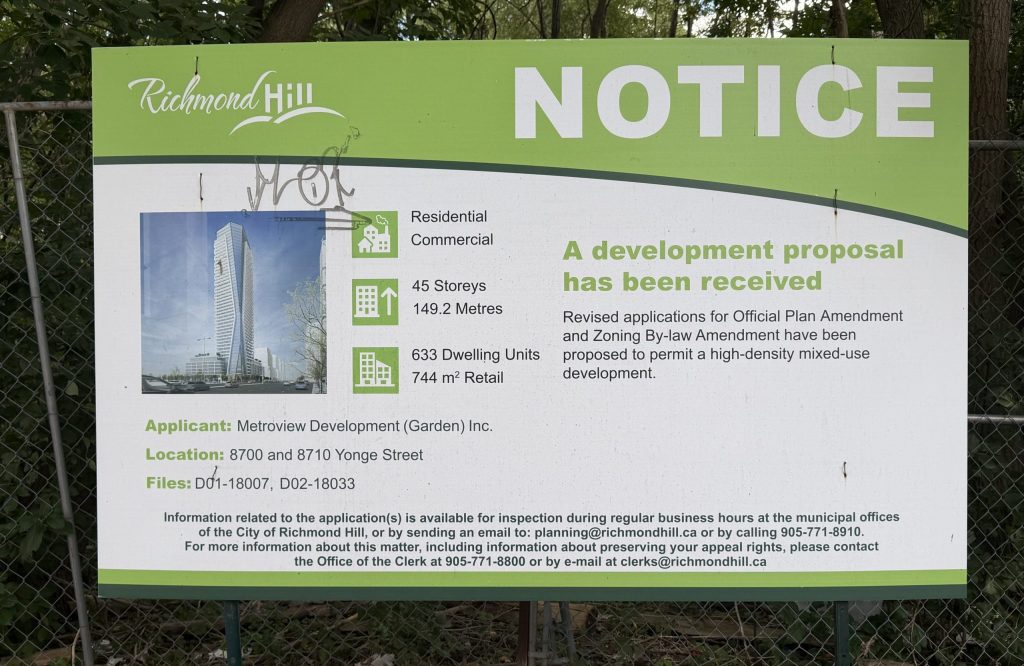
You chose your home in Ward 5 for a reason. Maybe it was the quiet street, the mature trees, or the comfortable spacing between houses.
Then, one day, a bright development notice appears on a nearby fence. The rendering shows a building much larger than you expected. It is natural to wonder:
- Is this already approved?
- Can I object?
- Who is actually listening?
If you see a development notice in Richmond Hill, start by checking the application details and the deadline for comments.
You do not need a degree in urban planning to navigate this. You just need to know where to look, what questions to ask, and how to put your concerns into the official process.
1. How to read a development notice in Richmond Hill
Let’s use a real example. The notice in the accompanying photograph is for 8700 and 8710 Yonge Street. It mentions revised applications for an Official Plan and Zoning By-law Amendment.
The sign highlights 45 storeys, 633 units, and retail space. Those details describe the proposal displayed when the photograph was taken. The application may have changed since then, so check the latest documents before relying on those figures.
The most critical details are at the bottom: the application numbers D01-18007 and D02-18033. Remember, an application notice alone does not mean construction has been approved. But it does not tell you how much time remains to participate, either.
These application numbers help City staff find the right files.
Take a clear photograph of the entire sign. Include the address, file numbers, contact details, and any meeting date. Check the application’s current stage and deadlines.
2. Find the facts, what is changing?
Before drafting an objection, understand the baseline. Ask questions: What is already permitted on this land, and what new permissions are being requested by the applicant?
Perhaps the proposal seeks greater height, more homes, or a building closer to neighbouring properties. Knowing the difference between existing permissions and requested changes helps you focus your response.
Richmond Hill’s Development Planning page and its Development Application Status Map are your best starting points. You can also email the assigned City planner directly or planning@richmondhill.ca to request the latest drawings and a plain-language summary of the requested changes.
You can ask: Could you help me understand what changes are being requested, which decisions remain open, and where I can find the latest plans and studies?
You do not have to read every technical document at once. Begin with the proposal summary and drawings, then follow the questions that matter most to you.
3. Translate your daily experience into actionable questions
It is easy to feel overwhelmed, but your daily experience of the neighbourhood is valuable data. Instead of general frustration, translate your concerns into specific questions for the City’s review process. You may know something that is difficult to see on a drawing: where water collects after heavy rain, where drivers struggle to see pedestrians, or which stretch of sidewalk children use each morning.
Describe it clearly. Connect the concern to a location, a drawing, or a requested change.
| Your everyday concern | What you can ask the City to examine |
|---|---|
| Privacy | Could windows, balconies, or building placement be adjusted to reduce overlooking of neighbouring yards? |
| Sunlight | Is a shadow study available? What does it show for neighbouring homes and outdoor spaces? |
| Traffic and safety | How were driveway locations, sightlines, and nearby pedestrian crossings assessed for peak-hour traffic? |
| Drainage | How would grading and stormwater arrangements affect nearby properties during heavy rain? |
| Trees | Which mature trees would be retained or removed, and what protection measures are proposed? |
| Building scale | How does the proposed height and massing relate to the existing character of the street? |
These questions identify matters for review, they do not guarantee that every requested change can be required.
Note: You can support the need for new housing in Richmond Hill while still asking for thoughtful, necessary adjustments to a specific proposal. It does not have to be a simple “yes” or “no.”
4. Look beyond the building, ask the infrastructure questions
A building drawing shows walls, windows, and balconies. Height and density often grab the headlines, but there is a quieter, equally important question: Can our existing infrastructure support these new homes?
The building footprint may tell you much less about the morning bus, the walk to school, or the capacity of the pipes underground. New residents need reliable water systems, safe streets, usable transit, schools, and access to everyday essentials.
When reviewing an application, ask what has been assessed for water, wastewater, and drainage. Ask what the relevant school boards and service providers have identified. Look at connections to transit, parks, community facilities, groceries, and pharmacies.
Then ask about delivery:
- What servicing improvements are needed?
- Who would pay for them and carry out the work?
- Will these improvements be completed before residents move in, or are they just future promises?
- How will new residents safely reach schools, parks, and transit?
Responsibilities are shared among the City, York Region, school boards, developers, and other providers. Approving homes does not automatically build a new school, widen a road or provide more frequent transit, or multiply nearby shops.
A good proposal should consider how new homes would fit into the neighbourhood and what services people would need. The timing and certainty of those improvements matter too.
5. Write down what you want reviewed or changed. Make your voice count in the official record
Chatting with neighbours is a great first step, but to make an impact, your concerns must be in the official record. Be specific and professional.
Instead of writing “Traffic is already terrible,” try this “I am concerned about pedestrian visibility at the proposed driveway, given the nearby school crossing. Please explain how sightlines have been assessed and if another driveway location was considered to reduce conflicts.”
For infrastructure, you might ask “Please identify the servicing upgrades needed for this proposal, who would deliver them, and whether they would be completed before occupancy.”
Include the address and application number. Follow the submission instructions, request confirmation of receipt, and keep a dated copy.
Richmond Hill’s delegation and correspondence page explains requirements for Council and committee submissions. Read the disclosure information before sending: correspondence can become part of the public record, including identifying information.
6. Make sure your comments reach the right decision-maker
Not every application goes to City Council for a decision. Richmond Hill’s Committee of Adjustment, for example, considers minor variance and consent applications through a separate process. It is an independent body appointed by Council.
Always ask the staff contact “Who is the final decision-maker for this file, and what is the deadline for public comment?” This ensures you are directing your energy to the right place.
Follow the instructions for that particular application and meeting. Do not assume that one meeting’s registration rules apply to another.
If important information is missing or your questions have not been answered, ask for answers before a decision is made. You can also ask for more time to review the proposal. The person or group making the decision may agree to wait, but does not have to.
7. Compare notes with your neighbours
One neighbour notices drainage. Another knows the difficult turn at the end of the street. Someone else walks the school route every day.
Bring those observations together in a short list of shared questions. Send it to the City with dated photos or examples that help explain the problem. Ask City staff how these concerns have been considered in reviewing the proposal.
8. Stay informed and know your options. Follow through after submitting
Sending your comments is one step. Keep track of what happens next. Request updates and notice of the decision. The City directs requests to join development application notification lists to clerks@richmondhill.ca.
When revised drawings or a staff report appear, look for your concern. Has the entrance moved? Has further information been provided? Does the report explain why a requested change was accepted or rejected?
Be aware that Ontario’s planning laws strictly limit who has the right to appeal a decision to the Ontario Land Tribunal (OLT), and deadlines are tight. Submitting an objection does not automatically grant appeal rights. If the stakes are high, consult a municipal planning lawyer before the decision is made, not after.
9. The bottom line
Public participation will not always stop a development, but it can help shape it.
It can lead to safer driveways, better setbacks, or secured infrastructure commitments. The next time you see that development notice, take a photo. Find the file. Then put your local knowledge into clear questions and explain what you want protected or changed.
That is how you turn an unfamiliar sign into a constructive conversation about the future of Ward 5.
What residents should expect from their councillor
Let’s be clear about what a councillor can do and which decisions are outside their control.
A councillor should listen to residents’ concerns, raise specific questions with City staff, and follow up for clear answers. Where changes could help, such as a safer driveway or more space between buildings, they should ask whether those changes can be made.
When a proposal comes before Council, a councillor should explain their position and vote, and keep residents informed about the decision and next steps.
A councillor cannot guarantee that a project will be changed or refused. Planning rules apply, and a councillor has one vote on Council, not full control over the final decision.
Read more about what a ward councillor can do and my priorities for Ward 5. You are welcome to contact me with a question about your neighbourhood.
What do you think?
Have a question, idea or suggestion about this topic? Share it privately with me.
Please include your name and email so we can reply. Your message will not appear as a public comment.