
Your House Didn’t Grow a Second Story. So Why Can Your Tax Bill Change?
City Hall Explained · By Yuliya Benedziktavich
Your house may look the same as last year. Your property tax bill may not.
Many people feel this. Some are working and still watch every dollar. Some are retired and live on less. The tax bill still has to be paid, along with food, heating, insurance and repairs.
Understanding the bill will not make it smaller. But it can help you see what changed, find help and ask better questions.
Why can the bill change when the house did not?
Your property tax depends on two things. The first is the value the province gives your home for tax purposes. This is called the assessed value. The second is the tax rate. Your tax does not depend on how much money you have this year. If you retire or lose your job, the bill does not go down by itself.
A provincial agency called MPAC decides the assessed value. It is not today’s price on the market. For 2026, Ontario still uses home values from January 1, 2016. The value can change if something is built or added to the property, such as an addition.
The City decides how much money it needs and sets its own tax rate. The same bill also includes taxes for York Region and for schools. So a bill can go up even when your house stayed the same.
Where does your money go?
You pay Richmond Hill, but the City keeps only part of it. The City’s 2026 budget announcement gives this rough split of the tax on a home:
Richmond Hill
City services, and things the City builds and looks after.
York Region
Services run by York Region.
Schools
Education.
These are rounded numbers. They are not the exact split on your own bill. Richmond Hill Council decides only the City’s part.
Richmond Hill Council has nine members: the mayor, two Regional Councillors and six ward councillors, one for each ward. Each member has one vote, so a ward councillor has one vote out of nine. You can read more about what a Ward 5 councillor actually does.
The mayor also has a special role in the budget. Under Ontario’s strong mayor rules, the mayor proposes the City budget each year. Council can change it, the mayor can veto those changes, and Council can overturn a veto only with a two-thirds vote.
For a wider look at how nearby cities spend money, see good ideas for City Hall worth sharing between Richmond Hill, Markham and Vaughan.
How to read your 2026 tax bill
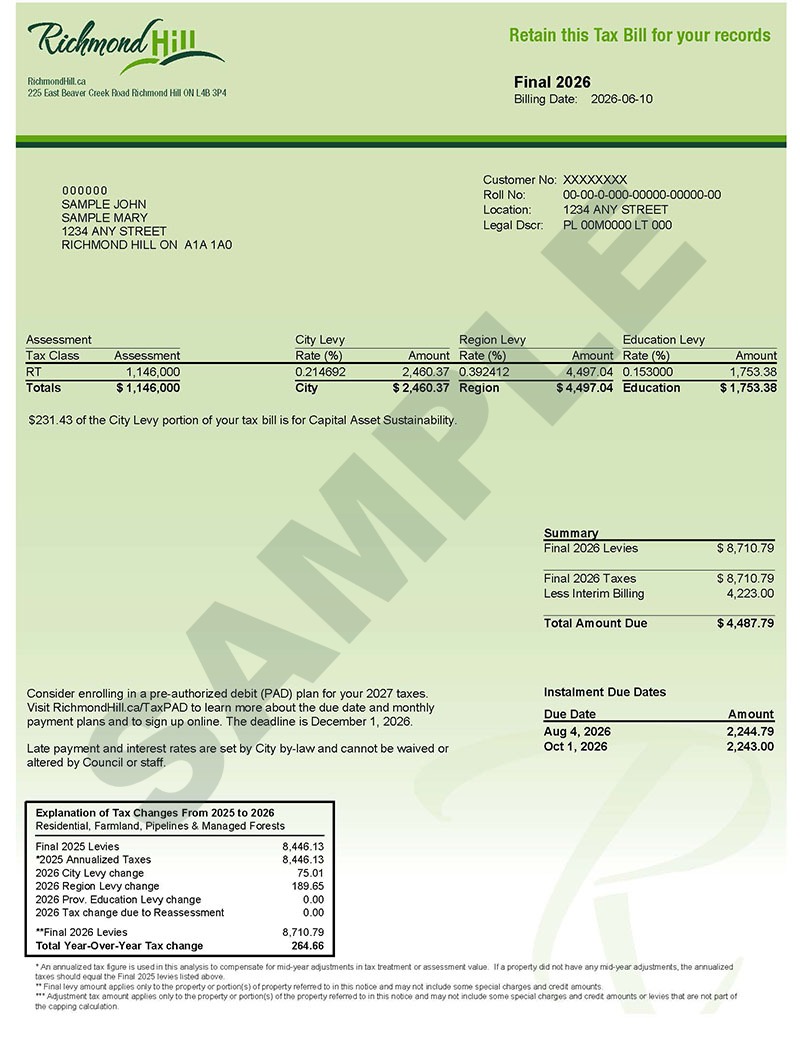
A sample 2026 final tax bill from the City of Richmond Hill. It is not a real household’s bill.
This is what the City’s bill looks like. The name and address on it are samples. Here is what to look for on your own bill.
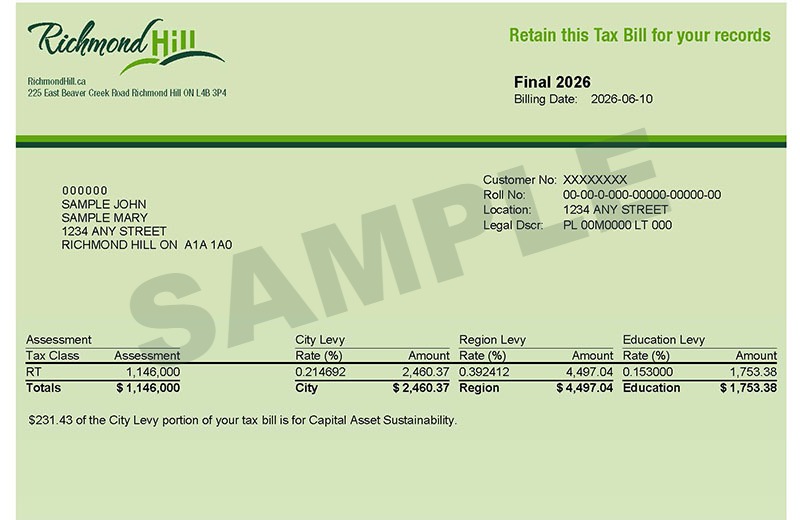
The City shows this sample. For a home valued at $1,146,000, the City part is $2,460, the York Region part is $4,497 and the school part is $1,753.
- Near the top there are three columns: City, Region and Education. These are the three parts of your tax.
- One line says how much of the City part is for the Capital Asset Sustainability charge. On this sample it is $231.43.
- The box called Summary shows the tax for the whole year. It takes off the bills you already paid and shows what is still due.
- The box at the bottom left, “Explanation of Tax Changes”, shows how much each part changed since last year. On this sample the City part went up by $75.01, the York Region part by $189.65 and the school part by $0.00.
What went up in 2026?
The City raised its own part of the tax by 3.46% for 2026. Of that, 1.96% pays for running City services. The other 1.5% is a special charge, called the Capital Asset Sustainability Levy, to repair and replace things the City owns, such as roads and community centres.
The 3.46% is only for the City’s part. It is not an increase on the whole bill. For an average detached house valued at $1,146,000, the City says its part goes up by about $6.29 a month. That value is for tax purposes. It is not the price you could sell the house for today.
A small amount can still be hard to find when your income has dropped and other bills are going up too.
If you work, the bill is still yours to plan for
The bill is based on your home’s assessed value, not on how much you earn. A raise does not change it, and neither does a lost shift. It is a yearly cost that you have to fit in with your mortgage or other payments, the cost of children and everything else.
The first bill of the year, called the interim bill, is usually about half of last year’s tax. The final bill comes later and works out the whole year. Do not be surprised if the second bill is different from the first. Here is why. The first bill is built from last year’s tax, so it does not know about this year’s rates yet. The second bill is built from this year’s tax, minus what you already paid. So the whole increase shows up in the second bill. If rates went up, the second bill can be bigger than the first. If they stayed the same, the two bills can be about equal.
Is there help when you have less money in retirement?
The programs below are for seniors. If you are not a senior, they do not apply to you, but you can still call the City and ask what else exists.
There is help. But retiring does not mean you get it automatically. Three programs are worth checking.
The City grant: $454 in 2026
Richmond Hill has a Senior Tax Assistance Grant. It is $454 in 2026. To get it, you must be 65 or older. You must receive the federal Guaranteed Income Supplement, called GIS. GIS is a payment for seniors with lower income. The home must be your main home. You must have owned it for at least one year, or be the owner’s spouse. You must apply every year. Only one grant is given for each household. If you are approved, the money is taken off your property tax account.
If you do not get GIS, you cannot count on this grant, even if money is tight. The City asks for a copy of your 2025 tax slip called T4A(OAS), or your 2025 GIS letter from Service Canada.
The Ontario grant: up to $500
This is a different grant. It comes from the province, not the City. You do not need GIS for it. For the 2026 grant, you must have been 64 or older on December 31, 2025. You, or your spouse, must have owned and lived in your main home on that date. The property tax for 2025 must have been paid.
The grant is up to $500. It gets smaller as your income goes up. It starts to shrink above $35,000 if you are single, separated, divorced or widowed, and above $45,000 for a couple. It stops at $50,000 for one person and $60,000 for a couple. Income here means the income on your tax return. You ask for this grant on your income tax return, using a form called ON-BEN.
Waiting to pay: the deferral
The City has a program that lets some people wait to pay part of their tax. It is for low-income seniors and for people with disabilities. It does not cancel any tax. When your tax goes up, the increase can wait, with no extra interest, until the home is sold or passes to someone else. Then it must be paid. You still pay the rest of your tax as usual.
The City’s detailed page says the senior route is for people aged 65 or older who receive GIS. There is a separate route for people with disabilities. You or your spouse must have owned the home on January 1 of the year you apply. It must be your main home. You must apply every year.
For someone who wants to stay at home, waiting can give some breathing room. But the money you wait to pay must be paid back one day.
Two City pages say different things about age
One City page, the tax bill questions page, says there is a waiting program for low-income people aged 55 to 64. Another City page, the list of tax help programs, says the senior program is for people 65 and older. It does not mention ages 55 to 64.
We cannot tell you which page is right. Please check for yourself. Call Access Richmond Hill and ask: Is there help for people aged 55 to 64? What are the rules? Which City page is correct?
If the next payment worries you
Call Access Richmond Hill at 905-771-8949. Keep your bill in front of you. Say what has changed and ask which programs fit you. The Ontario grant is separate. You ask for it on your income tax return.
The City’s deadline for the grant and the waiting program is September 30 every year. The 2026 deadline has passed. Ask what you can still do now, and when you can apply for next year.
For the City grant: if the City gets your application by March 31, it counts toward that year’s final bill. If it arrives between April 1 and September 30, the City still looks at it, but you must still pay the whole final bill on time. If you do not, there are penalties and interest.
When you compare bills, look at the whole year, not one payment. The first bill, called the interim bill, is usually about half of last year’s tax for the full year. The final bill later works out the full year and takes off what you already paid.
What would a City tax freeze change?
You may hear the words “tax freeze”. Ask two things. What exactly is frozen? And how is it paid for?
Richmond Hill announced 0% City tax increases for 2021 and for 2022. But in 2021, the special charge to repair and replace City things still went up by 1%. In 2022, the City used one-time money from its savings, called reserves, for some projects. It also hired 16 new firefighters and spread the cost over five years.
The City’s published tax rate for homes still went from 0.180124% in 2021 to 0.181692% in 2022. That is a rise of about 0.9%. So “0%” in a headline is not always the same as your own bill staying the same.
A City freeze would only cover the City’s part. York Region and the schools set their own.
People can fairly ask: What happens after the first year? Will the savings come back every year? Is one-time money being used for costs that come back every year? Will repairs be put off and cost more later? What happens to the services people use?
What could help over time?
Check spending. The City could look closely at what it buys, its contracts, software, outside consultants and the full cost of new projects. These are places to look. They are not proof that money is being wasted. Public spending is also one of the priorities on Yuliya’s Ward 5 page: Accountability for How Public Money Is Spent.
Look at the help programs. Who gets help? Who misses out? Can people find out about the help easily? More help costs money, so any change needs clear rules and a way to pay for it.
New businesses can help a little, sometimes. A new store, office or factory also pays property tax. If that tax is more than the cost of serving it, the City may not need to ask other taxpayers for as much. But this is not automatic, and your bill may not go down. When a new shop opens in a building that already pays property tax, the City does not get a new tax bill. The building was already on the list. The City gets new tax money mainly when something new is built.
None of this proves that a freeze can be paid for. These are questions to answer first.
Staying at home is the real question
For a household with less money coming in, the question is simple: can we keep living here? For a working family it is much the same: can we plan for this bill and still pay for everything else?
A good answer needs bills people can understand, help people can reach, and a budget that explains both today’s cost and tomorrow’s.
Before you decide or apply
This article gives general information, checked against official sources in October 2026. Amounts, rules and deadlines can change, and your own situation may be different. Please confirm with the official source before you apply or decide how to pay.
Access Richmond Hill: 905-771-8949
Email: access@richmondhill.ca
Official sources
- City of Richmond Hill, About Your Tax Bill
- MPAC, 2025 roll-return release
- MPAC Fact Sheet
- City of Richmond Hill, Richmond Hill Sets 2026 Budget
- City of Richmond Hill, Budget (Senior Tax Assistance Grant, $454 in 2026)
- City of Richmond Hill, Senior Tax Grant
- City of Richmond Hill, Senior Tax Grant 2026 guide (PDF)
- Canada Revenue Agency, Ontario Senior Homeowners’ Property Tax Grant
- City of Richmond Hill, Tax Assistance Programs
- City of Richmond Hill, 2021 tax freeze announcement
- City of Richmond Hill, 2022 tax freeze announcement
- City of Richmond Hill, Tax Rates
- City of Richmond Hill, Final Tax Bill, front page (sample bill)
- City of Richmond Hill, Mayor and Council
- City of Richmond Hill, City Clerk presentation on strong mayor powers (June 28, 2023)
- Ontario, Municipal Councillor’s Guide: the role of council, councillor and staff (2018)
What do you think?
Every family looks at the tax bill from its own perspective. Share your thoughts and ideas about it privately with Yuliya.
Your message will not appear as a public comment. Your name and email are required so the team can reply.